Introduction
In this guide, I hope to provide some additional insight and techniques for what is termed in the literature as “male multiple orgasms” (hereafter referred to as penis-owner multiple orgasms). Currently, much is unknown about penis-owner multiple orgasms. After talking to some of the top researchers on the topic, such as Erik Wibowo and Beverly Whipple, I have learned more about what little we know and about problems with past studies.
Quite surprisingly, we still do not have reliable technologies and methods to detect whether someone is having an orgasm. This is especially true for cases of prostate orgasms, non-genital orgasms, orgasms reported in phantom limbs, and orgasm without contractions and emission of semen. Furthermore, there is currently no research into which proposed techniques work most and which do not work at all.
Yet, despite the lack of scientific data, many penis-owners of all ages have described having some form or orgasm or forms of orgasm consecutively. Because the word “orgasm” has been used to describe many different feelings and experiences, I will describe it very broadly: Orgasm is a climax in a sensation.
Historically, orgasm has been defined more narrowly. In 1966, Masters and Johnson’s Human Sexual Response detailed a four-phase model to penis-owner sexual activity consisting of an Excitement Phase, Plateau Phase, Orgasm Phase, and Resolution Phase. This model can be useful for understanding penile orgasms, but it is possible that non-genital orgasms do not follow these phases in the same way with the same mechanisms.
1. Excitement Phase
- Vasocongestion
- Erection
- Increased heart rate
- Partial Testicular Tumescence (Size Increase)
- Nipple erection
2. Plateau Phase
- Further increase in penis tip size and testicles
- Full testicular elevation
- Purple hue on corona (although not always)
- Cowper’s gland (pre-cum) secretions
- Hyperventilation
3. Orgasm Phase (Orgasm & Ejaculation)
- Orgasmic Pleasure
- Ejaculation
- Myotonia (Muscular Rigidity)
- Blood Pressure and Respiratory Rate Increase
- Bladder sphincter closure
- Rhythmic contractions of the anus, prostate, perineal muscles and penile shaft
- Altered State of Consciousness
4. Resolution Phase (Refractory Period)
- Erection Loss
- Inability to Experience Orgasm
- Increased Penile Sensitivity
- Sudden Decrease in Libido
- Increased Relaxation and Drowsiness
- Testicular Detumescence to Baseline Level
- Myotonia and Vasocongestion Return to Baseline Level
- Heart Rate and Lowered Blood Pressure Return to Baseline Level
Masters and Johnson’s four-phase model has orgasm and ejaculation under the orgasm phase, but they are different phenomena. Masters and Johnson were likely aware of this, especially with them being familiar with Kinsey’s work on multiple orgasms in penis-owners. They just did not make the distinction in their model.
In short, orgasm is the climax of pleasure. Ejaculation is the process of moving ejaculate through the urethra. Both processes can occur without the other such as in cases of non-ejaculatory multiple orgasms, anorgasmia with ejaculation, or undesired anejaculation with orgasm.
When most penis-owners describe experiencing multiple orgasms, they typically describe experiencing many of or a combination of the following:
- Penile orgasm with ejaculation
- Penile orgasm preceding ejaculation
- Prostate orgasms and anal orgasms through external or internal massage
- Orgasms of other body regions
In this guide, I will focus on the top two. For information on prostate orgasms, I recommend the Aneros Prostate Massager forums or r/prostateplay on Reddit. A good post is About 30 years ago, I learned to have multiple anal/prostate orgasms with EVERY session. : multiorgasmic (reddit.com). For non-genital orgasms, there are some good posts on FetLife. For multiple penis-owner squirting, please see: https://sextoys-india.shop/blog/male-squirt/ and (PDF) Male squirting: Analysis of one case using color Doppler ultrasonography (researchgate.net).
Multiple Penile Orgasms with and without Ejaculation
A few studies like the following have detailed multiple orgasms in men. Most of these studies detail multiple ejaculatory orgasms because the emission of ejaculate makes them easier to study.
- Exploring Male Multiple Orgasm in a Large Online Sample: Refining Our Understanding – PubMed (nih.gov)
- Multiple Orgasms in Men-What We Know So Far – PubMed (nih.gov)
- Male multiple orgasms: a descriptive study – PubMed (nih.gov)
- Male Multiple Ejaculatory Orgasms: A Case Study: Journal of Sex Education and Therapy: Vol 23, No 2 (tandfonline.com)
- Sexual Behavior In The Human Male : Alfred C Kinsey
Even with these studies, much is unknown about multiple orgasms and even orgasm in general. Despite the lack of scientific understanding, the notion that penis-owners can have multiple orgasms has been around for many centuries, having its origins in sexual tantra. Many how-to guides, such as those on the following websites, mention tantra sex techniques to have multiple orgasms. Other techniques come from sex therapists like Masters and Johnson’s squeeze technique published in Human Sexual Inadequacy (1970) and originally intended to prevent premature ejaculation. Some examples are
- Male multiple orgasms (sexinhumanloving.com)
- https://www.mindbodygreen.com/articles/multiple-orgasms-for-men-guide
- How Men Are Biohacking Multiple Orgasms (thedailybeast.com)
- Love Satisfies by Keepitup Johnson
- Multiorgasmic men: Why it happens and when it’s too much. (slate.com)
- Male Multiple Orgasms – TheToy.org
- https://slate.com/human-interest/2022/01/multiorgasmic-man-too-much-advice.html
- https://moderntantra.blogspot.com/2016/02/understanding-male-orgasm.html?m=1&zx=570161c81f5ee87
In articles like these, many techniques are mentioned. For non-ejaculatory orgasms, I’ve seen many techniques:
- Breathing techniques
- Prostate stimulation
- Anus stimulation
- Deep-spot stimulation
- Perineal stimulation
- Nipple stimulation
- Vagus nerve stimulation
- Stomach stimulation
- Vibrator stimulation
- Impact play
- Neuro-linguistic programming
- Kegels
- Pressing the perineum right before ejaculation
- Rubbing only the head of the penis
- Glans only or base only stimulation
- Edging (Start-and-stop style, ruined orgasms, 50% edging, flaccid edging, only kegels, mental-only stimulation, or no penis touching)
- Pinching the urethra
- Visualization
- Electro-stimulation
- Jack Johnston’s Key Sound
- Moving energy around the body
- Meditation
- Stimulating the internal penis
- Relaxing the body
- Rewiring the brain through quitting porn
- Only stimulating the penis when flaccid
- Recreational drugs
- Erection-enhancing drugs
- Semen retention
- Music and biaural beats
- Reiki and other spiritual practices
For multiple ejaculatory orgasms, most approaches focus of staying motivated after orgasm or being able to reach a subsequent orgasm:
- Watching pornography after ejaculation
- Continuing to play with a partner after ejaculation
- Using stroker toys and vibrators to force more orgasms
- Taking Viagra and other erection-aiding substances
- Enhancing the experience through recreational drugs
- Using drugs that are intended to decrease the post-ejaculatory refractory time
Although many approaches have been proposed for multiple orgasms, I do not know the success rates of the techniques. I just know what works for me. I have tried most of the above, and I have found most success with what I call precision edging for multiple non-ejaculatory orgasms and the progressive stimulation technique for maximizing multiple ejaculatory orgasms.
Precision Edging for Multiple Non-Ejaculatory Orgasms
A non-ejaculatory orgasm is a climax of sexual pleasure typically lasting 6 to 15 seconds that is not followed by ejaculation. There is no refractory period since the refractory period is linked to ejaculation. You can have another non-ejaculatory orgasm seconds after the previous non-ejaculatory orgasm or minutes later. Importantly, a non-ejaculatory orgasm is different from anejaculation, a type of sexual dysfunction where no ejaculation occurs and then there is a refractory period. The opposite, anorgasmia, can also happen, which is when ejaculation occurs, but no orgasm precedes. Non-ejaculatory orgasms do not reach the ejaculatory stimulatory threshold, only the orgasm threshold. In penis-owners with healthy sexual function, ejaculation should be possible if one increases stimulation very slightly after a non-ejaculatory orgasm. Just like ejaculatory orgasms, non-ejaculatory orgasms vary in intensity, perhaps even more so. Orgasms may be more intense than ejaculatory orgasms or very light.
If you pay close attention to your orgasm and ejaculation, you may notice that you feel the orgasm 1 or 2 seconds before you ejaculate. Many penis-owners stimulate so intensely or broadly that they occur so close together that orgasm and ejaculation are felt so close together than they are indistinguishable. When you experience orgasm, you have either met or exceeded the psychological and stimulatory threshold to have that orgasm. When you experience an ejaculation, you have either met or exceeded the psychological and stimulatory threshold to have that ejaculation. Each orgasm has its own threshold to meet before orgasm can occur. The threshold is very dependent on the individual, their sensitivity, their sexual health and function, level of arousal, and refractory period length. This threshold almost always changes with each given orgasm. Stimulation, therefore, is a balancing act. Awareness of how much more stimulation is needed for the next orgasm can be learned through practice and precise approaches.
Traditional edging involves stroking the penis and repeatedly stopping right before orgasm. I have found this technique to not be very effective and sustainable. I would get very close to orgasm but be likely to have an ejaculatory orgasm or get right up to the point where I feel orgasm is starting and stop. More times than not, I’d end up ejaculating after a few stops and starts. It is akin to running to the end of the cliff and stopping before falling off. In contrast, precision edging is where one stimulates continuously through non-ejaculatory orgasms by stimulating enough to reach the orgasm threshold but not the ejaculatory threshold. I liken this to tiptoeing with confidence on the edge of the cliff or carefully walking on the tightrope of pleasure. The thresholds for orgasm and ejaculation are extremely close together, so I came up with precise approaches that help produce the right amount of stimulation for unbelievable amounts of orgasms and pleasure.
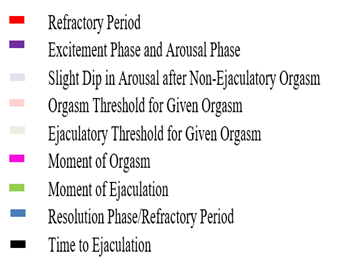
The diagram below shows the orgasm and ejaculatory thresholds in light pink and grey, respectively. They have been plotted along Masters and Johnson’s four-phase model. Notice how the dip in arousal following a non-ejaculatory orgasm in light purple compared to the ejaculatory orgasm in blue. With non-ejaculatory orgasms, you can have another non-ejaculatory orgasm, or you can decide to ejaculate shortly after a previous non-ejaculatory orgasm. In contrast, ejaculatory orgasms have a larger dip in arousal and a lengthier refractory period in which orgasm cannot occur. Of course, they are not mutually exclusive. You may be able to have 15 non-ejaculatory orgasms, have an ejaculatory orgasm, wait some time, have 20 more non-ejaculatory orgasms, have an ejaculatory orgasm, wait some time, and have 25 additional non-ejaculatory orgasms, wait some time, have 30 additional non-ejaculatory orgasms, have an ejaculatory orgasm, and then have even more.
Model of Ejaculatory and Non-Ejaculatory Multiple Orgasms


Through reading experiences of others, I suspect that two intermediary stages of penile-centric orgasms exist between the orgasm and ejaculatory thresholds. Some individuals describe contractions with their non-ejaculatory orgasms, while others describe partial ejaculations with their multiple orgasms. These, to my knowledge, have never been modeled or explained.
My intermediary threshold hypothesis describes why this may occur from a stimulatory hypothesis perspective in lieu of a neuro-physiological explanation. The intermediary threshold hypothesis states that intermediate stimulatory thresholds between the orgasm and ejaculatory threshold exist given by their unique physiological presentation. This hypothesis adds to the findings that orgasm and ejaculation are separate points in the arousal cycle. The intermediary thresholds are the Contractual Non-Ejaculatory Orgasm Threshold (consisting of no ejaculation, contractions, and no refractory period) and the Partial Ejaculatory Orgasm Threshold (consisting of partial ejaculation, contractions, and no refractory period). They are modeled with the orgasm and ejaculatory thresholds below.
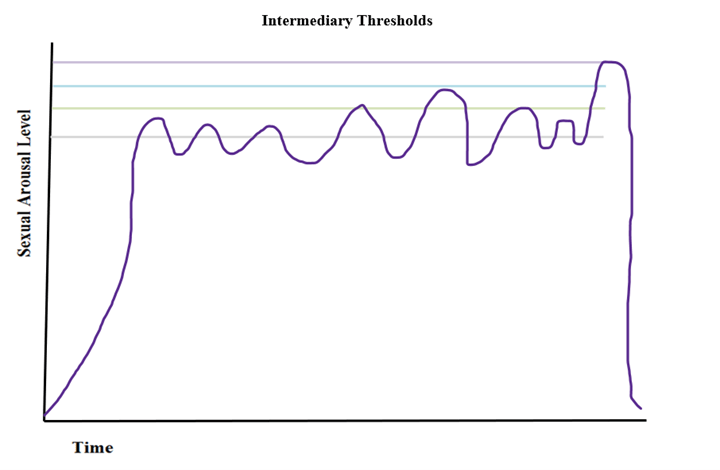
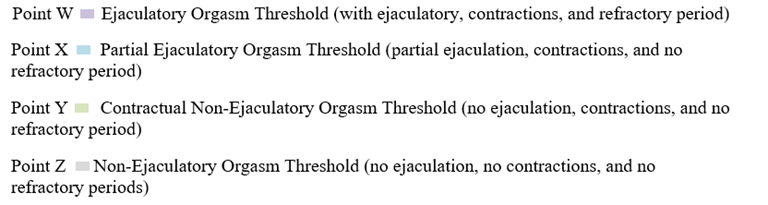
To precision edge, you stimulate the penis until you feel orgasm is close. Once close, you try to get as close to orgasm as possible. Once you are close to the orgasm threshold, it is time to precisely stimulate the penis, enough to orgasm but not enough to ejaculate. To optimize non-ejaculatory orgasms, I try to stay at points Z and Y and way from X and W. The Regional Stimulation Method can be used to stay at Z and Y and away from X and W until a partial ejaculatory orgasm or an ejaculatory orgasm is desired.
The Regional Stimulation Method is a technique for precision edging.It is common for penis-owners to masturbate with their hand in a tight grip and stroke up and down. The regional stimulation technique is much less stimulating, so it is more conducive to precision edging.I recommend learning it through masterbation as it is much more difficult to do through the larger stimulation of the vagina, with your focus on your partner, and with the increased excitability and the biological urge to ejaculate inside their vagina or anus. The technique involves using the sensitivity of a region on the penis to . The diagram below was shows the sensitivity according to the regions: A Frenulum, B Glans and Regions Next to Frenulum, C Middle of Penis, D lower 3rd of penis, E Lower 5th of penis, F Very bottom of penis, and G Beside penis or stimulation of internal penis through perineum. When you find a spot that brings you too close to ejaculating, such as A or B, you can move down to C through G for less intense stimulation that is more controlled.
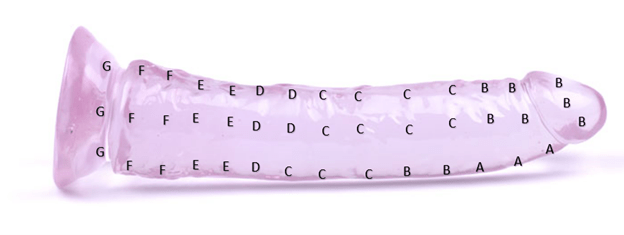
Rowland, David L. “Penile Sensitivity in Men: A Composite of Recent Findings.” Urology 52.6
(1998): 1101-105. NCBI. Web.
Schober, Justine M., Heino F.l. Meyer-Bahlburg, and Curtis Dolezal. “Self-ratings of Genital
Anatomy, Sexual Sensitivity and Function in Men Using the ‘Self-Assessment of Genital
Anatomy and Sexual Function, Mens’ Questionnaire.” BJU International 103.8 (2009):
1096-103. NCBI. Web.
Once getting close to orgasm using the stimulation of your choice, you can figure out how you like to touch yourself with less pressure, speed, and stimulation to have non-ejaculatory orgasms. I prefer to use either pinpoint vibration or rubbing with one or two fingers on a spot of my penis. The vibrators I like to use are depicted below. Each has the capibility of producing very little vibration, so that you can be precise with your edging. From right to left, they are a biothesiometer, multi-speed battery-operated vibrator, rechargeable multi-speed vibrator, and a multi-speed miniwand.
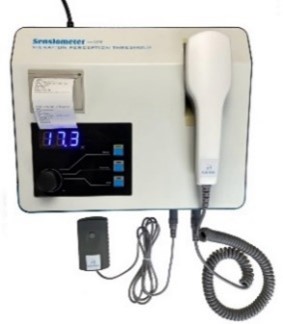
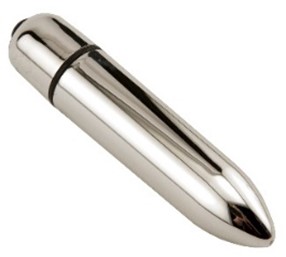
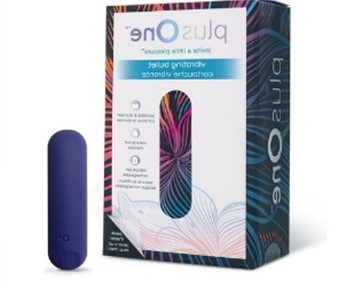
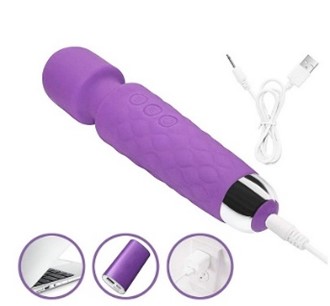
The biothesimeter is a medical tool that tests nerve sensitivity. I found one on Ebay and decided to buy it and masturbate with it to see how far my precision edging could take me. It was so precise and light of a vibration that I could confidently precision edge. While high as a kite, I had over 100 orgasms in about 40 minutes, keeping it right on spot A most of the time. The bullet vibrator can have much of the same effect, but I find myself using lower regions like D through G when the lowest setting is enough to make me ejaculate. A trick to use when at the orgasm threshold is to use the bullet vibrator backwards, so that you are only feeling the transferred vibration and not the full vibration at its source. This will give you more control and precision. Unlike more powerful vibrators, stroker toys, or stimulation with a hand, the stimulation is so precise that starting and stopping is not necessary. The light stimulation can be continuous, as you have orgasm after orgasm coming, fading, and coming again.
The miniwand is my go-to for everyday use, but I tend to use bullets for prolonged sessions of precision edging. I stimulate on high until I feel close to orgasm and then hold it as low on my penis as possible, at the part where the penis enters the testicles, with my erect penis laying on my abdominals. As part of my nightly quickie, I have at least 5 to 10 non-ejaculatory orgasms, ejaculate, and then go to bed. All except the biothesiometer can be purchased for less than $25.Other vibrators can be employed if these vibrators are not strong enough. I can sometimes precision edge with much stronger vibrators, like the Hitachi, and stroker toys after 8 or 9 ejaculatory orgasms. However, in most cases, these powerful vibrators will just force an ejaculation because the stimulatory threshold for orgasm is too quickly exceeded.
It may take some time for you to precisely stimulate to orgasm without hitting the ejaculatory threshold. Mind-orgasm-threshold connection is important to recognize orgasm. Noting meditation can help build awareness of an orgasm’s building, arriving, remaining, and fading. Some orgasms will be almost unnoticeable, while others will be moderate to incredibly intense. Try counting orgasm length to get an idea of how long you will feel each climax. As you build awareness, you will be able to distinguish what points of sensation coincide with each threshold, which will help refine your technique as a precision edger. In addition, please remember that the stimulatory threshold for each given orgasm changes. After 40+ minutes of orgasms with even the lightest vibrators, it’s common to be numb, so instead of decreasing vibration to hit the targeted stimulatory threshold, you might need to increase the intensity or change the type of stimulation from a vibrator to fingers.
After experiencing a series of non-ejaculatory orgasms, you can choose to ejaculate or can take a break for, say, five minutes, and then come back for more. I find this helps sometimes if I am having many orgasms and need to rehydrate or find some music to enjoy. Sometimes I have partial ejaculations during non-ejaculatory orgasms. It is not a full ejaculation, because I do not have a refractory period afterward until I fully trigger the ejaculatory reflex through more stimulation. This happens when I stimulate extremely close to the ejaculatory threshold, where only like three drops of ejaculate comes out. I can have multiple non-ejaculatory orgasms within seconds of this initial spurt, usually accompanied by a couple involuntary anal contractions. For me, contractions happen on some non-ejaculatory orgasms, but do not really correlate with the intensity of the climax.
After having multiple non-ejaculatory orgasms, I feel like my body is flooded with pleasure chemicals and desire for love and intimacy, not sleepy like after an ejaculatory orgasm. If I continue to ejaculate, the feeling of orgasmic high is still there, but it’s combined with the exhausted feeling.
Precision edging with the regional stimulation method has been essential in my joy of non-ejaculatory orgasms. You may find other techniques listed earlier that did not work for me. Non-ejaculatory orgasms can take some trial and error. It took me years to figure out and years to master. I’m not sure how long it would take to learn with the information already available. I would guess anywhere from a week to a couple years in penis-owners with healthy sexual function. I will update this guide as more information is available.
Multiple Ejaculatory Orgasms
Multiple ejaculatory orgasms are orgasms that are combined with ejaculation. If you have had at least one orgasm in your life, it is most likely an ejaculatory orgasm. It is common for those who first discover masturbation to masturbate many times a day, having a short refractory period. This refractory period tends to increase with age and ranges from minutes to days.
Many penis-owners can ejaculate many times a day, and few have very short refractory periods. In a masturbation competition called the Masturbate-a-thon (http://web.archive.org/web/20100515122221/http://www.masturbate-a-thon.com/records.html), the reported record for multiple orgasms in one day was set by Michael Hariprem in 2008 who had thirty-one orgasms. It is unknown how they kept track of the orgasms and if they were ejaculatory. However, a case study describes a participant who experienced six ejaculatory orgasms in 36 minutes in 24 hours. It is unclear if some of the six were partial ejaculations, which can happen with non-ejaculatory orgasms, or if these were full ejaculations.
When people typically talk about multiple ejaculatory orgasms, they generally refer to one of two things: Multiple orgasms throughout the day or multiple orgasms in a short time. I recognize them as both abilities, but they need to be distinguished. Multiple orgasms in a short time I call consecutive multiple orgasms. Multiple orgasms throughout the day I call periodic multiple orgasms.
Consecutive multiple orgasms are repeated ejaculatory multiple orgasms that occur close together. Unlike having multiple non-ejaculatory orgasms, which do not contain the refractory period or resolution phase, a penis-owner having ejaculatory orgasms will experience all four of Masters and Johnson’s four stages of arousal.
There is no agreed-upon definition for multiple orgasms. I decided to create a spectrum definition for consecutive multiple orgasms that depends on time between orgasm phases:
- Time between Orgasms: 0-5 Minutes = Highly Multi-Orgasmic
- Time between Orgasms: 6-10 Minutes = Moderately Multi-Orgasmic
- Time between Orgasms: 11-15 Minutes = Mildly Multi-Orgasmic
- Time between Orgasms: 16-20 Minutes = Marginally Multi-Orgasmic
With this scale, many teenagers fall within the mildly or marginally multi-orgasmic range, having a naturally shorter refractory period. Older individuals are less likely to experience consecutive ejaculatory orgasms close together. Nonetheless, recent research has suggested that age is not much of a factor in determining one’s ability to have multiple non-ejaculatory orgasm, with some participants over the age of 70 (Exploring Male Multiple Orgasm in a Large Online Sample: Refining Our Understanding – PubMed (nih.gov)).
Periodic multiple orgasms are defined as orgasms spaced periodically throughout the day. Periodic multiple orgasms are not usually considered to be multiple orgasms in studies that I have mentioned herein. However, I have encountered posters on forums, such as Reddit, that consider this as a multi-orgasmic ability. I agree. Consecutive multiple orgasms can be compared to a sprinter, whereas periodic multiple orgasms can be likened to a multi-orgasmic marathon runner. If one can have consecutive multiple orgasms, one can have periodic multiple orgasms. Yet, few who can have periodic multiple orgasms can have consecutive multiple orgasms. Younger penis-owners tend to be more likely to experience periodic multiple orgasms.
The technique I use for consecutive multiple orgasms and periodic multiple orgasms is the same. While precision edging can be useful for multiple non-ejaculatory orgasms, a technique I named the progressive stimulation technique can help maximize multiple orgasms. Notice that I said maximizing. There are many ways to have 3 to 8 ejaculatory orgasms in a day that penis-owners have used. However, my technique is helpful to have 12 or more ejaculatory orgasms. My record was 16 ejaculatory orgasms in 8 hours. If I would have had the whole day to myself, I might have had more.
If you ever masturbated or had sex multiple times a day, you may feel tired or unmotivated for more sex, and your penis can feel numb and desensitized (especially after using a powerful vibrator) or sensitive to the touch. The progressive stimulation technique is useful to reduce numbness and sensitivity to touch. For the tiredness and motivation for sex, you’d know that best. I find that playing should not be too late at night, being around a high-sex drive partner, and strategically inducing fantasy and porn can be useful to renew desire for more ejaculatory orgasms and perhaps some non-ejaculatory beforehand. I’ve found that watching porn too early can be counterintuitive because I get too excited on orgasm 1 and do not save much excitement for orgasms, say, 8 and 9. Plus, if you are too excited, too soon it is more difficult to have non-ejaculatory orgasms before each multiple ejaculatory orgasm. Saving your favorite turn-ons or pornography for later can also help. Plus, anticipation alone can be a motivator.
Before using the progressive stimulation technique, you need to identify the minimum about of stimulation required to reach the ejaculatory threshold and have an ejaculatory orgasm. This can take some time and practice, so it is good to set aside some time without distractions and to be patient. The amount of stimulation required to have an ejaculatory orgasm is a little more than what was required to reach the orgasmic threshold. The amount of stimulation required to have each subsequent ejaculatory orgasm tends to increase after each ejaculation. It may take 5 minutes for the first orgasm but 30 minutes for the tenth orgasm.
To use the progressive stimulation technique for your first ejaculatory orgasm of a series, you will need to be as gentle as possible to make your penis not numb, sensitized, desensitized, or chafe. I will reference the diagram for the regional stimulation method from earlier when explaining this technique.
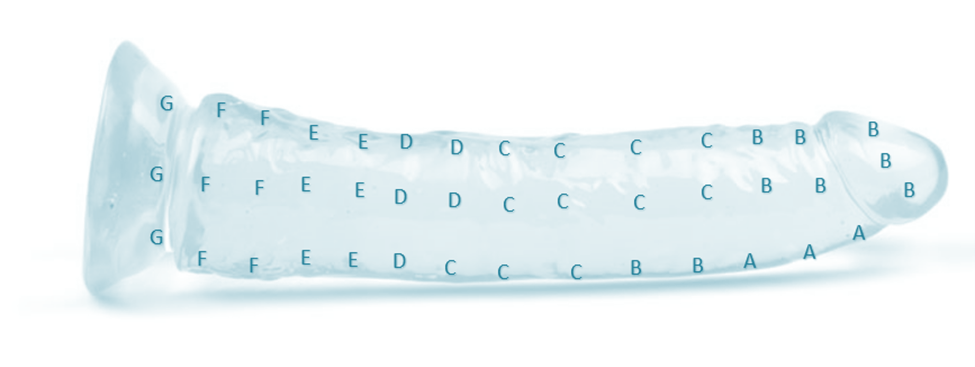
For the first ejaculatory orgasm, I recommend stimulating either G or F, depending on which can get you off. You can use a light vibrator like a bullet on the lowest setting possible, your fingers in a “perfect” sign, or one or two fingers to massage a small area. Pressure should be as light as possible, and speed should be as low as possible. Essentially, you are saving the sensitivity of the rest of the penis for when it is needed in later orgasms. At this step, I prefer to be very meditative and not worry about fantasy or pornography. I am using only my body. If you can orgasm with your mind alone, however, this is the time to do it. If you need to use A or B, I recommend using as light a vibrator and as little pressure as necessary.
For the second ejaculatory orgasm, I like to either slightly increase the vibration, pressure, or speed of my fingers on G or F. You can experiment with increasing the stimulation or region of stimulation by moving up to E or D. I find that increasing stimulation on a lower region is preferable to moving up since regions close the frenulum (A), which become hypersensitive more quickly.
For the third ejaculatory orgasm, you may be able to use the same stimulation as one of the previous orgasms, either G or F. This is what I ideally try to do. If you need more stimulation, either increase the speed of your finger, hand, or vibrator, or change the region of stimulation up higher on the penis. Slow intercourse or oral sex can be akin to the level of stimulation that I use at this level.
For the fourth ejaculatory orgasm, I gradually increase the stimulation and vibration. I might switch to my miniwand vibrator and choose a lower setting and increase the setting with each orgasm until the maximum speed is reached and I am stimulating region A with pressure. You will need to see what your body likes. I use the miniwand for as long as it works, having up to 8 ejaculatory orgasms. Occasionally I will use my hand to give my body a break from vibration. Whatever works and desensitizes, sensitizes, or chafes least is best. Medium to very hard, tight, and wet intercourse can be akin to the level of stimulation that I use at this level.
Once the weak vibrators or even your hand is too weak that the new ejaculatory threshold is very difficult to reach or unreachable, I recommend either a stroker toy or stronger vibrator, like a Hitachi, Doxy wand, or percussion massager with a towel for padding. At this point, the regional stimulation method is not as useful. Its purpose is to get you into later orgasms, before you need to bring out the big guns. Feel free to watch your favorite porn while you’re at it, or save for later if you still feel like you can bust a couple more out. You may need to bring in the big guns much sooner if the weak ones are not working for you. I still recommend starting on regions G and F and working toward regions B and A and seeing what works for you.
For ejaculatory orgasms 9 and onward, I force them out of myself with powerful vibrators on region A or stroker toys. I do whatever I can to reach the ejaculatory threshold. I press my penis into a Sybian, attach a stroker toy to a fucking machine, pound my penis with a percussion massager, and bare down with a powerful wand.
A Concluding Note
I do not recommend continuing if you feel extremely sore, nauseous, dizzy, dehydrated, fatigued, or stupefied, unless you really want to break some world record. After extreme amounts of non-ejaculatory orgasms and ejaculatory orgasms, I experience brain fog, difficulty thinking, dehydration, a headache, dizziness, drowsiness, tiredness, fatigue, and nausea. To decrease side effects, I prefer to have non-ejaculatory orgasms (after which I feel more love drunk) and just a few ejaculatory orgasms. For this reason, I try not to operate machinery after a day of many orgasms. I hope that these techniques bring you much joy and many orgasms.
 Multiple Os